Strategy is Trading Bitcoin's Power Law Trend
Originally published on X
Related Research
Bitcoin Price Models
Bitcoin has been trading below its power law trend since October 10th, 2025.
During this period, Strategy has gone from 19% amplification to 37% amplification, with 64% of new capital raised via $STRC, and just 34% raised via $MSTR.
During this same period, MSTR traded down from 1.8x MNAV to 1.2x MNAV.
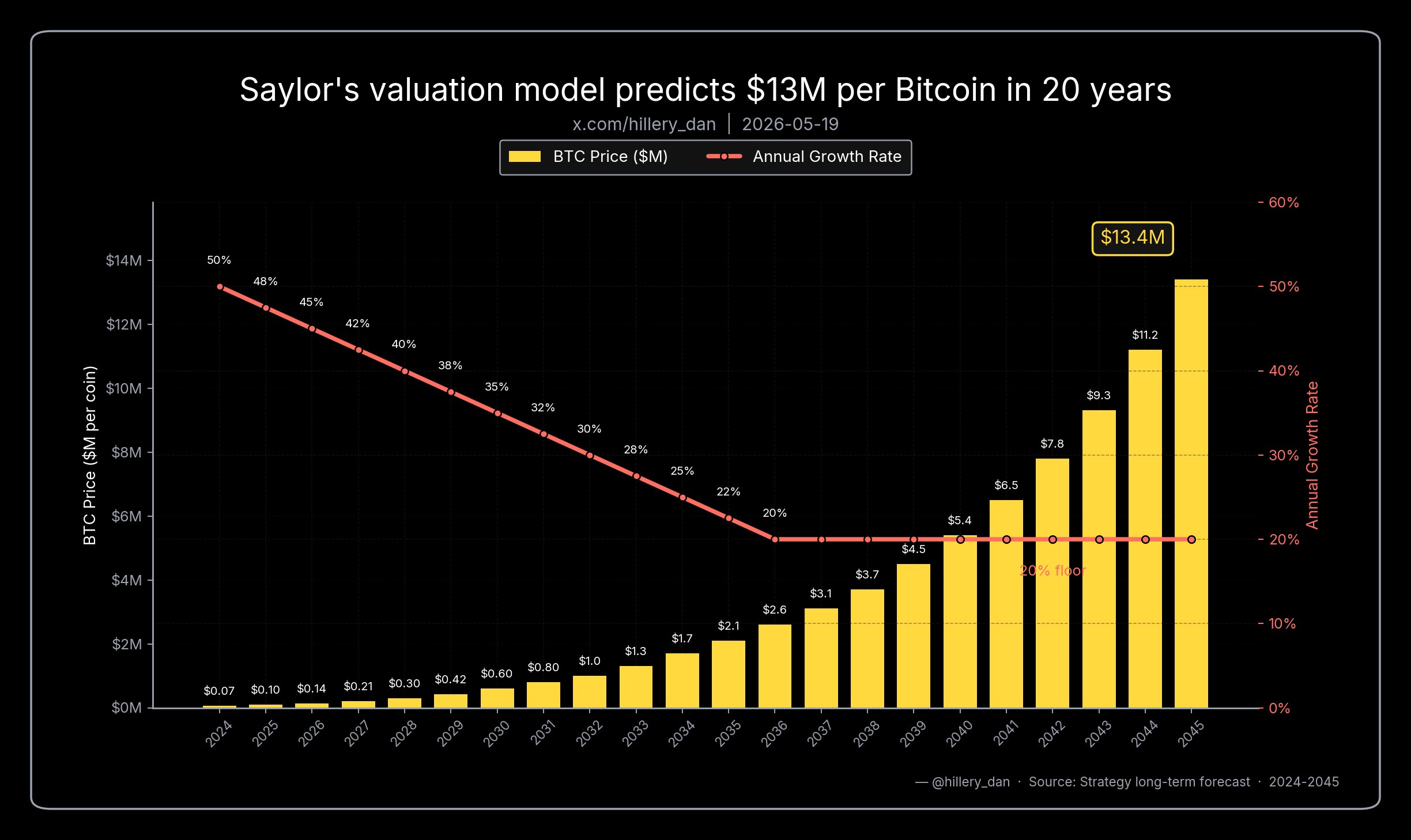
In Saylor’s most recent interview with James Van Straten of CoinDesk, he discusses prioritizing “harmony and equilibrium of what’s credit positive and whats equity positive. If we hit the right balance everyone wins.”
By most metrics, including relative to the power law trend, Bitcoin’s price is suppressed. Strategy is clearly increasing its amplification at these lower prices, betting that Bitcoin is near the lows. This additional amplification will increase both the BTC yield and BTC gain over the coming years if the Bitcoin bottom has in fact happened.
MSTR & Bitcoin Relative Value
I’ll offer a model.
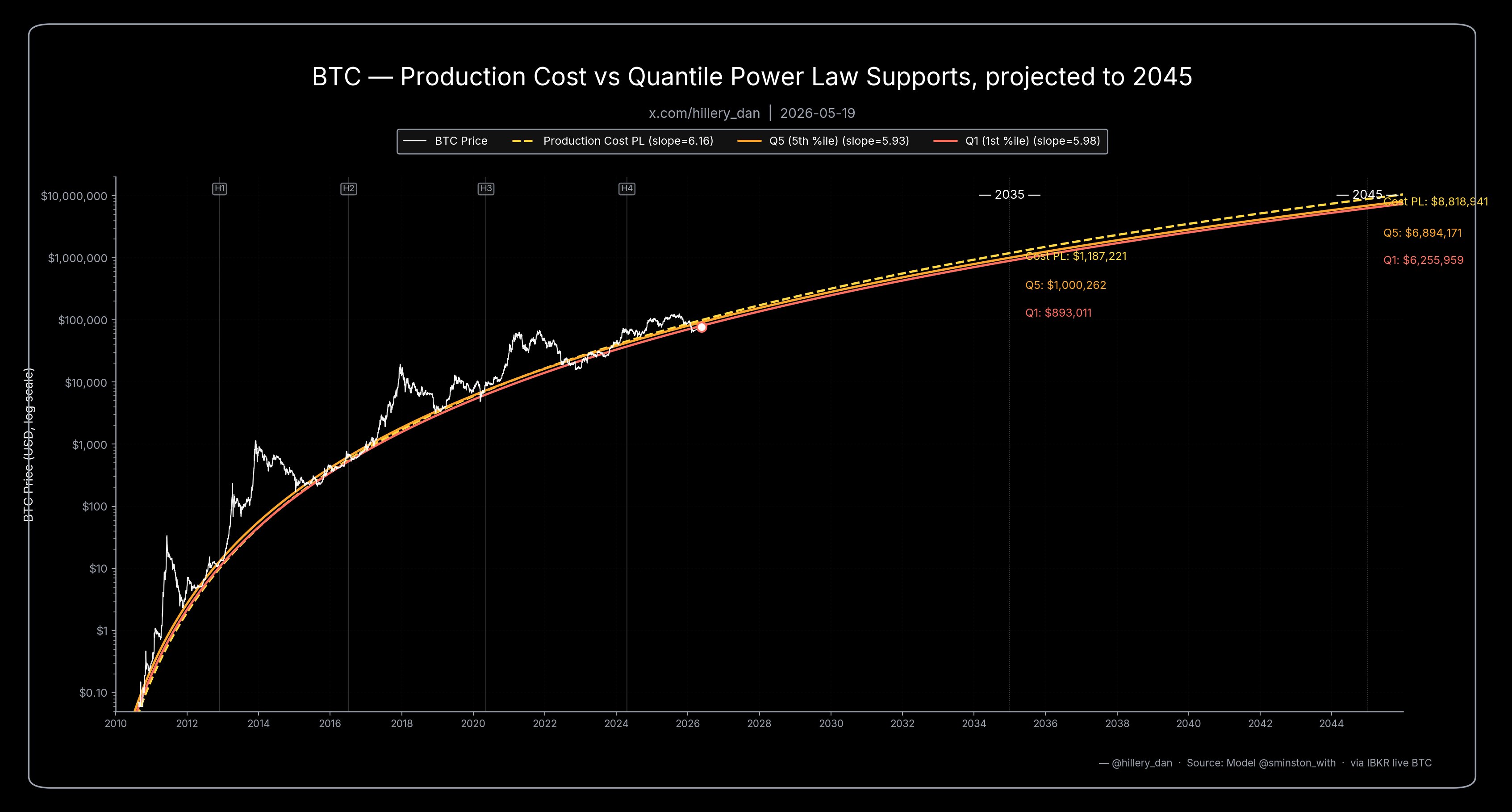
Strategy is 37% amplified, and Bitcoin is sitting at 0.58% of the power law trend, which is relatively in line with Saylor’s Bitcoin model and projects an average price of $140k during 2026.
If Bitcoin were well above the projected growth rate of either Saylor’s model or the Bitcoin Power Law, I wouldn’t expect such a high leverage ratio.
Now they can always de-amplify the capital stack by issuing common equity in the case that Bitcoin falls.
I’d argue, however, that it’s in Strategy’s best interest to do this proactively. Obviously they will remain long Bitcoin only, but more importantly, they have affirmed their north star KPI as Bitcoin yield.
Bitcoin yield is only accrued to the common via STRC issuance if Bitcoin rises in price faster than STRC’s cost of capital after the Bitcoin was purchased. (Some people will argue this is not the case, but it is, considering BTC/share is a metric that governs the amount of Bitcoin held by common holders in the case of liquidation; therefore, you must subtract out the liquidation preference of the preferred equity from this calculation.)
STRC issued at lower Bitcoin prices is much more accretive to MSTR common shareholders than STRC issued at higher Bitcoin prices, relative to BTC’s price trend.
Is Strategy Being Honest?
While Strategy has been vocal in maintaining a net long position in Bitcoin, there is no reason why they can’t buffer the amount of amplification it carries. Next time Bitcoin breaks above all time highs, will they allow the amplification ratio to contract as the price of Bitcoin expands?
This has a lot to do with STRC demand, but I will argue that they should de-lever the balance sheet via accretive common MSTR issuance as much as they can when Bitcoin is above the power law trend.
MSTR & STRC Demand Oscillate Around the Power Law
As we sit here cheap relative to the historic trend, Strategy’s MNAV multiple is too low to offer accretive common equity issuance on a BTC/share basis.

Levering up on STRC while there is demand makes logical sense, if you believe Bitcoin’s price to be mean reverting.
Once Bitcoin goes back into it’s expansion phase, I expect the MNAV multiple to expand. If this occurs, the result is that common equity issuance will once again be accretive to BTC/share.
The higher Bitcoin deviates from its long-term trend in the short term, the more accretive equity issuance becomes, and the greater the risk/less accretive issuing perpetual preferred becomes.
Let’s say Bitcoin is “4 years ahead of support” as defined by @apsk32. This means that it will take 4 years for the floor of the power-law trend to catch up to Bitcoin’s current price.
The increased MNAV + the increased downside risk in Bitcoin price make common equity issuance a much more valuable tool and will naturally de-lever Strategy’s balance sheet at the highs, whereas STRC’s appeal at the lows naturally re-levers the balance sheet.
Strategy has created a dynamic, like a pendulum, that shifts issuance between MSTR and STRC depending on where Bitcoin is along its price curve. This back-and-forth of issuance, so long as Bitcoin trends higher over time, accrues BTC/share for the common shareholder relentlessly.
Cycle After Cycle, Year After Year
Over time, Strategy will continuously execute this trade. We witnessed the MNAV expansion and BTC/share accretion during the 2024 blowoff top. This was a de-leveraging event.
Right now we are witnessing the re-leveraging of the balance sheet using STRC. This amplification will bring about the outperformance of MSTR relative to Bitcoin in the next bull run, which will spark the MNAV premium expansion once again.
This is the rinse-and-repeat cycle. Lever at the lows with STRC, outperform Bitcoin on the way up, de-leverage on the way down by issuing common at a premium and expanding the Bitcoin collateral on the balance sheet.
Easier said than done.
This is how Strategy seeks to outperform Bitcoin.

Founding Member
Dan Hillery is a Founding Member of True North. He covers macro strategy, derivatives, preferred equities, and Bitcoin price modeling. Dan was profiled in the Wall Street Journal for his MicroStrategy investment thesis.
Related Research
Balancing of MSTR and STRC
Mar 16, 2026
AnalysisSTRC, Bitcoin's Exponential Pump, MSTR to 20k & BTC to 5MM — Money, The Perfect Product
Jan 21, 2026
AnalysisBitcoin Is Missing a Central Bank. Strategy Is Building One.
Jan 26, 2026
AnalysisHiding in Plain Sight
Jan 20, 2026
Research PaperTrust Is Civilization's Oldest Technology
Aug 13, 2026
CommentaryStrategy Q1 2026 Earnings Call — Full Q&A Notes
May 5, 2026