The Income Statement Is the Obituary. The Balance Sheet Is the Will.
Related Research
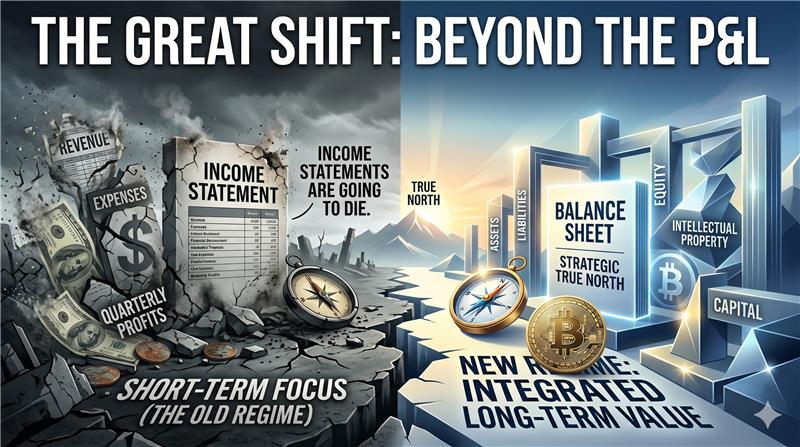
The equity market is scoring the wrong game. Here is what happens when you re-score the league using its own math.
By Jeff Walton, Chief Risk Officer, Strive
The Scoreboard Is Broken
Imagine two neighbors.
Neighbor A has a great job paying $200,000 a year. Spends most of it. Rents a nice apartment. Leases a BMW. On paper: high income. “High growth.”
Neighbor B makes $80,000 a year at a boring job. But every spare dollar for fifteen years went into owning his house outright, then a second house, then a third. Low income. Massive balance sheet.
For forty years, Wall Street has been obsessed with Neighbor A. What’s your income this quarter? What’s guidance? What’s the growth rate? Discounted cash flow. P/E ratios. Forward earnings. The entire vocabulary of modern equity analysis is about Neighbor A.
Nobody asked Neighbor B what he owned. He was “boring.”
Then the dollar started losing purchasing power at a rate that finally became impossible to ignore. The M2 money supply has compounded at roughly 6.7% annually for the last fifty years. This isn’t new. The pain is finally being felt en masse. Neighbor A’s salary buys less every year, and his landlord raises the rent. Neighbor B owns three houses outright, and his balance sheet got a tailwind he didn’t lift a finger for.
That is the regime change. The equity market hasn’t priced it in yet.
The Denominator Problem
Every “growth” number in finance is in dollars. Revenue grew 12%? In what? If the unit of account lost 7% of its purchasing power, you only grew 5% real. Corporate America has spent a generation running a marketing campaign where the ruler shrinks every year and they brag about the measurements.
There is no such thing as a growth rate independent of the currency you measure it in. Re-measure the S&P 500 in gold ounces or Bitcoin and most of the “growth stories” of the last decade flatten out dramatically. Many go negative. The growth was nominal, denominated in a shrinking unit. It was never real.
Clean money is a ruler that doesn’t shrink. Gold did this job for five thousand years. Bitcoin does it now with a twist: fixed supply, global liquidity, and, critically, it’s accessible inside a corporate balance sheet.
Debt Past the Point of Return
US federal debt now exceeds 120% of GDP. You don’t pay that down. You inflate it away. History is unanimous: every sovereign at this level has reached for the same tool.
In this regime, the dumbest asset you can own is a long-duration cash-flow promise denominated in a debasing currency (private credit, corporate credit, investment-grade bonds, long-dated Treasuries, pensions, structured-income annuities). The smartest is the hardest asset on the other side of the trade.
Ten-year Treasuries lost more than 20% of their real value between 2021 and 2023. Most market participants called that a bond market correction. It was something far more important. It was the moment the so-called risk-free rate stopped pretending. Risk-free was always a societal construct, not a property of the asset. The reason FDIC insurance exists, the reason the Fed has a printer, the reason there is a “lender of last resort” at all, is that the underlying instruments are not actually risk-free. The risk premium has always been paid. It just gets paid in inflation of the money supply rather than in default. Once enough holders realize that, capital has to find a new safe. Historically that has been gold. This cycle, for the first time, gold has a credible digital competitor with finite supply.
The Three Questions Every Investor Should Be Able to Answer
Three questions sit underneath every equity decision. Almost no one can answer them cleanly.
What is an equity actually worth? The textbook says the discounted value of future cash flows. That answer only holds if the discount rate is real and the currency is stable. Neither is true anymore. An equity is worth what it lets you store.
Why do people actually hold equities? There are really only three reasons. Some hold equities for current income, structuring dividends and coupon-like cash flows to match living expenses, retirement spending, or future liabilities. Some hold equities for capital appreciation, hoping the share price grows faster than their costs. But the third reason is the deepest and the least articulated: people hold equities to store purchasing power across decades, because the alternative (cash) decays faster than they can earn it back. The growth story is the wrapper. The real product is the store of value, with structured income layered on top to fund the present.
Is there a moment when the regime shifts from growth-of-cash-flow to growth-of-balance-sheet? Yes. We’re in it. The signal was the risk-free rate giving up the ghost. The confirmation is happening quietly now: quality compounders with real balance sheets are being re-rated, while glamorous growth names are priced for a denominator that’s dying.
A Quick Primer on Balance-Sheet Quality
Before the test makes sense, one piece of vocabulary. We need a way to score how good a company’s balance sheet actually is, not just how big.
A bigger balance sheet isn’t automatically a better one. JPMorgan has a bigger balance sheet than Visa, but Visa generates more economic value per employee and per dollar of physical plant than JPMorgan ever could. Costco runs an enormous operation but the balance sheet itself is thin and slow. Strategy, by contrast, runs a tiny operation (1,546 people, almost no buildings) sitting on top of a balance sheet that does an extraordinary amount of work per year.
I use a single number to capture this. I call it the Capital Efficiency Score, or CES. It rewards companies that generate a lot of return on equity, that wield outside capital (deposits, premiums, customer floats, convertible balances) on top of their own equity, and that do all of it with as few people and as little physical infrastructure as possible. The exact math is below in its own section. For now, just hold the intuition: high CES means a balance sheet that punches far above its weight. Low CES means a balance sheet that needs an army to move it.
When you rank the fourteen companies in this analysis by CES, Strategy is in a different orbit. Their CES is roughly 2.7x the second-highest score (Nvidia’s) and roughly 300x the lowest (Costco’s and Tesla’s). The market is not currently paying for that.
The Parity Test
How do you visualize a regime shift? How do you price one? Different business models compound differently. Some compound through cash flow. Some compound through balance-sheet capture. The honest test is to ask what rule the market is actually using right now to price all of them, then apply that rule consistently and see who is far off the line.
I took fourteen of the most scrutinized equities in the S&P (Apple, Microsoft, Google, Amazon, Meta, Nvidia, Tesla, Costco, JPMorgan, Berkshire, Visa, Mastercard, Progressive, and Strategy) and ran a series of regressions on the thirteen non-Strategy names. Each regression asks the same question: across these thirteen real, currently-trading companies, what relationship best explains how the market actually values them today?
One thing to be clear about up front. Every regression below uses today’s reported numbers. Today’s market caps. Today’s equity. Today’s earnings. Today’s CES. This is a static snapshot of the league as it stands right now, with no assumed future growth in any company’s balance sheet, earnings, or Bitcoin holdings. If the static numbers are this far off, that is a finding worth sitting with on its own.
I tested four specifications, because any single regression invites a fair objection.
Spec A: Balance sheet only. ln(Market Cap) = a + b·ln(CES) + c·ln(Equity). This rewards balance-sheet quality and balance-sheet size. It says nothing about earnings.
Spec B: Earnings-controlled balance sheet. ln(Market Cap) = a + b·ln(CES) + c·ln(Equity) + d·ln(Net Income). This is the bear’s preferred model. Add net income directly so a company can’t look “cheap” just because it has a large balance sheet relative to its earnings.
Spec C: Pure earnings comparable. ln(Market Cap) = a + b·ln(Net Income). The conventional Wall Street view. Companies trade on earnings, period.
Spec D: Earnings plus balance sheet, no CES. ln(Market Cap) = a + b·ln(Net Income) + c·ln(Equity). Acknowledges both, without reaching for a custom efficiency metric.
Then I applied each of these market-derived rules uniformly to all fourteen companies, including Strategy. Same rule for everyone. No special pleading.
Here is what the data suggests for Strategy specifically:
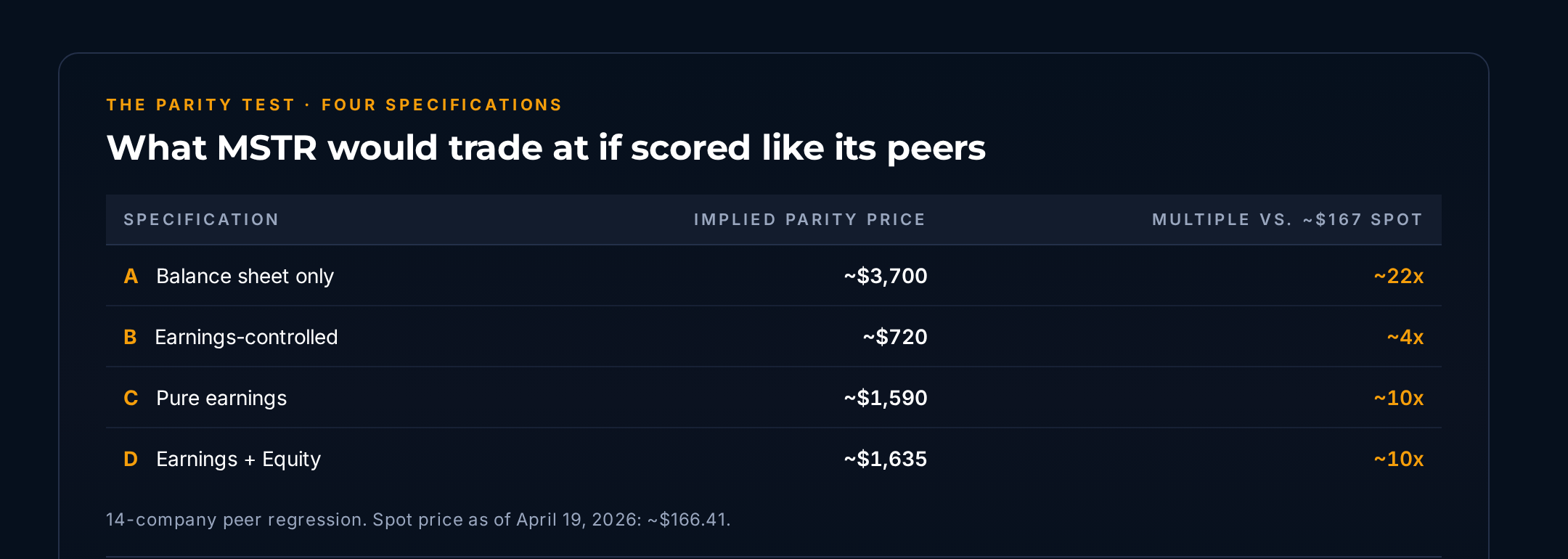
Read that table carefully. The bear’s model (Spec B), the one designed to kill the balance-sheet argument by directly controlling for earnings, still implies Strategy is roughly 4x its current price. The earnings-only Wall Street view (Spec C) implies 10x. The balanced specification (Spec D), which credits both earnings and balance sheets, implies 10x. The pure balance-sheet view (Spec A) implies 22x.
There is no honest specification of the market’s own pricing rule that puts Strategy near today’s price. The range is 4x to 22x. The midpoint is roughly 10x. Across every reasonable rule, the verdict is the same: Strategy is materially mispriced, and in the same direction.
That is the parity test. It isn’t a forecast. The forward views of all fourteen companies are already baked into their current market caps. The test simply applies the market’s own pricing logic across the set and surfaces the inconsistencies.
How to Read the $3,700 Number Specifically
The Spec A number, the most-cited one in the Strategy debate, deserves to be unpacked because the math is doing real work.
The regression on the thirteen non-Strategy names produces a market-cap formula. Plug Strategy’s CES (9,691, by far the highest in the set) and Strategy’s equity ($58 billion) into that formula and you get an implied market cap of roughly $1.4 trillion. Divide that by Strategy’s fully-diluted share count (~382 million as of April 19, 2026, per Strategy’s IR disclosure including all convertibles, options, and unvested stock grants) and you get roughly $3,700 per share. Spot is about $167. Hence the 22x figure.
The reason this number is so high is that Strategy’s CES is in a different orbit from every other company. Their balance sheet works much harder per employee and per dollar of physical infrastructure than any peer in the set, by an order of magnitude. The narrower specifications compress the result for different reasons. Spec C ignores the balance sheet entirely and prices everything off net income, which is the conventional Wall Street view. Spec B includes the balance sheet but lets net income do most of the explaining, which penalizes a company like Strategy whose current accounting earnings are small relative to the asset base it’s accumulating. Spec D credits both. None of these is wrong as a framing. They are just different views of the same set of facts. And every one of them, even the bear’s preferred Spec B, still leaves Strategy a multiple of where it trades.
What Capital Efficiency Score Actually Measures (The Math)
For anyone who wants the formula, here it is.
CES = (ROE × (1 + Float / Equity)) × 10,000 / (Employees per $B equity + PP&E ratio × 100)In plain English: take the return on equity, magnify it by how much external float (deposits, premiums, settlement floats, customer deposits, convertible balances) the company is wielding on top of its own equity, then divide by how many employees and how much physical plant the company has to run to do it.
Strategy scores extraordinarily high for two reasons. First, they wield significant float (about $11 billion of preferred and convertible structures) on top of $58 billion of equity, all of it deployed into a single hard asset. Second, they do it with 1,546 employees and almost no PP&E. Visa, by comparison, posts a CES of 960 with 28,800 employees. JPMorgan posts 1,350 with 318,000 employees. Strategy posts 9,691 with 1,546.
The chart below shows the full set on a log scale. Strategy is alone on its tier. Costco and Tesla, two of the market’s most beloved compounders, score 31 and 31 respectively.
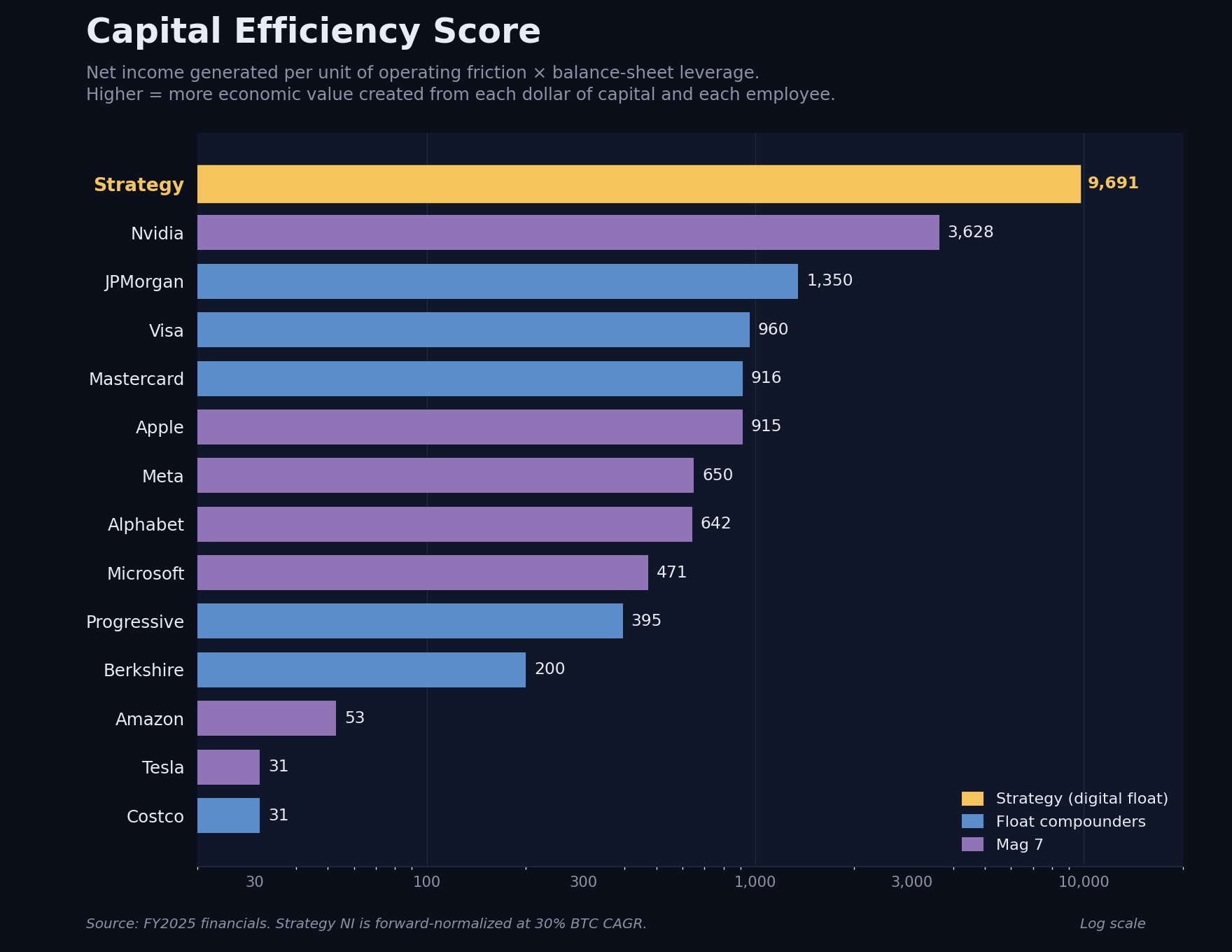
The market is paying more for the 31-CES business (Costco, at a 52 P/E) than for the 9,691-CES business (Strategy, at a 4 P/E). That gap is the entire point. The market has stopped pricing efficiency. It is pricing narrative.
Why Balance Sheets Win When Money Decays
Three concrete episodes from history.
Japan, 1990 to present. Japanese equities spent thirty years in real-terms purgatory. The survivors were not the best growth-plan companies. They were Toyota, Keyence, Shin-Etsu. Fortress balance-sheet names. Toyota’s cash reserve eventually became the product. The growth story died. The balance sheet kept compounding.
Weimar Germany, 1919 to 1923. The German stock market hit nominal all-time highs week after week. Measured in gold or foreign currency, it was collapsing. The only winners owned hard assets.
Buffett and See’s Candies. Buffett stopped obsessing over accounting earnings and started obsessing over what a business owned and could redeploy. See’s was a cash-compounding balance-sheet story dressed up as a candy company. His sixty-year empire is a single sustained bet on this thesis. Saylor is running the same play with a better reserve asset.
The pattern repeats every time a currency decays: growth-of-cash-flow loses, growth-of-balance-sheet wins, and the market is late to figure it out.
A Word on the Mag 7
Look at the parity table again and the Mag 7 names cluster on the wrong side of the line. Tesla, Apple, Nvidia, Google, Amazon all come out overpaid by 30 to 60% under the balanced specification. That is going to make a lot of people stop reading. It shouldn’t.
This is not a thesis against the businesses. The Mag 7 are extraordinary companies and they may dominate the global economy for another decade before any of this matters to their share prices. Apple’s ecosystem is real. Nvidia’s chip lead is real. Google’s distribution is real. None of that is in question.
The question is what you are paying for those qualities, and what assumption that price is built on. The Mag 7 won the last cycle because they built businesses where the marginal cost of an additional unit of software, an additional API call, an additional ad impression, or an additional advanced chip approached zero. Marginal cost near zero, plus a defensible moat, equals enormous gross margins, which equals enormous earnings, which equals enormous market caps. Wall Street priced these companies for a permanent regime where moats lasted forever and marginal costs stayed near zero.
But software moats decay. The cost of building a Google-quality search engine in 2026 is a tiny fraction of what it was in 2016. The cost of building a Tesla-equivalent EV is a fraction of what it was in 2018. AI is collapsing the cost of producing software, designing chips, and generating media. The thing that built the Mag 7 market caps (high marginal-cost barriers to substitution) is precisely what AI is dismantling. The half-life of every moat in this group is shrinking, even if the absolute cash flows are still growing.
Meanwhile the valuations are still priced for permanence. Apple at 34x earnings. Nvidia at 41x. Tesla at 240x. These multiples assume the moat compounds for another decade and the dollar denominator stays roughly stable. Both assumptions are at risk. If marginal cost falls and the unit of account erodes, you get a double compression: fundamentals weaken at the same time the discount rate rises in real terms. The businesses can keep dominating their categories and the share prices can still stagnate or fall. Those are different statements.
The Mag 7 may have another five or ten great years as businesses. The argument here is just that the prices already paid for those years, several times over.
A Note on Fiat-Denominated Balance Sheets
The regression names Progressive, Berkshire, and JPMorgan as the three biggest balance-sheet-quality stories after Strategy. That deserves a moment of honesty, because all three of those balance sheets are denominated in dollars, and the entire thesis of this article is that dollars are the problem.
A fiat-denominated balance sheet is not a hard-money balance sheet. A bank deposit base, an insurance float, and a settlement float all decay in real terms when the currency decays. Berkshire’s cash hoard is losing real value every year it sits in T-bills. JPMorgan’s deposit book funds loans denominated in the same shrinking unit. Progressive’s float is invested mostly in fixed income.
So why do they still come out as winners in this analysis? Because the market today is pricing narrative growth and almost completely ignoring balance-sheet capital. In a regime where balance sheets matter again, owning a real one (even a fiat one) beats owning none. The relative value shifts toward Berkshire, JPMorgan, and Progressive, because they at least have something to redeploy when the music changes. They are the second-best expression of the thesis. Not the cleanest, but second-best.
Think of it as a hierarchy:
- Digital credit issuers running a hard-asset balance sheet. A small, new category. Public companies whose entire reason for existing is to convert fiat liabilities into Bitcoin reserves at industrial scale. Strategy is the largest and most-scrutinized example. A small number of other public companies, including Strive, are pursuing variants of the same playbook. The denominator inside the balance sheet does not decay, which makes this the cleanest expression of the regime thesis.
- Fiat-denominated balance sheets that compound faster than the currency decays. Berkshire, Progressive, JPMorgan. They lose ground to hard-asset compounders, but they gain ground against companies with no balance sheet at all.
- Narrative-priced businesses with strong margins but no balance sheet to speak of. Most of the Mag 7. They get hit by both blades: AI compresses the moat, debasement compresses the multiple.
- Long-duration cash-flow promises denominated in fiat. Long bonds, private credit, corporate credit, pensions. The worst place to be.
Digital credit issuers sit at the top of that hierarchy. Berkshire, JPMorgan, and Progressive are the partial expression. The Mag 7 is the most exposed. Long-duration fiat credit is the trap.
The Regime Change, In One Line
This is, in fact, an argument about Strategy. It is also more than an argument about Strategy. The same framework flags Berkshire, JPMorgan, and Progressive as balance-sheet-first stories the market is mispricing in the same direction, just with the added asterisk that their balance sheets are denominated in the asset that’s losing ground. Strategy is the largest current expression of the digital credit issuer model because the asset inside its balance sheet does not decay. Other public names (Strive included) are running variants of the same playbook at smaller scale. The fiat balance-sheet names are partial expressions of the same thesis.
That is the regime call. Capital is going to reprice away from narrative-driven, cash-flow-promise equities and toward balance-sheet compounders. It is going to happen whether Wall Street is ready or not, because the force driving it has nothing to do with sentiment. The force is the slow-motion failure of the dollar as a unit of account.
The question is not whether Strategy is expensive. The question is whether the dollar is. If the dollar is the cheap thing and always declining, then owning a company whose job is to trade dollars for Bitcoin at industrial scale is the most rational equity strategy of the next decade.
The market hasn’t figured that out yet.
That is the opportunity.
Disclosures
The views expressed in this article are the personal views of the author and do not represent the views of Strive, Inc., Strive Enterprises, or any of their affiliates (collectively, “Strive”). This article was not prepared, reviewed, or authorized by Strive. The author is the Chief Risk Officer of Strive and personally holds shares of Strategy (MSTR).
This article is for informational and educational purposes only. It is not investment advice, a recommendation, or a solicitation to buy or sell any security. Statements about the future are forward-looking and reflect the author’s opinions as of the date of publication; actual outcomes may differ materially. The regression analysis described herein is a static, model-based exercise based on publicly reported figures and is subject to the limitations described in the accompanying mathematical appendix. Past performance is not indicative of future results. Readers should consult their own financial, legal, and tax advisors before making any investment decision.

Host
Jeff Walton is Chief Risk Officer at Strive and CEO of True North. He hosts True North Weekly and co-hosts The Hurdle Rate Podcast, covering Bitcoin treasury strategy, capital structure, and macro analysis.
Related Research
Michael Saylor Broke the Sharpe Ratio with $STRC
Apr 8, 2026
CommentaryStrategy Q1 2026 Earnings Call — Full Q&A Notes
May 5, 2026
AnalysisSTRK at $400 will Dominate Strategy's Trading Volume
May 1, 2026
AnalysisFlow-Adjusted Yield (FAY) for $STRC and $SATA
Apr 8, 2026
AnalysisSemi-monthly STRC Divs Will Increase Monthly STRC ATM to $10B
Apr 20, 2026
CommentaryThe Original 1,000x — Standard Oil Is Happening Again
Mar 15, 2026